
Article: How to Choose Ballet Flats for Work: Comfortable, Stylish Shoes for the Office
How to Choose Ballet Flats for Work: Comfortable, Stylish Shoes for the Office
This week, I've been taking part in a pop-up at Westfield London in White City, and I've found myself doing something I always enjoy: shoe watching.
Spend a few hours watching people come and go and you start to notice how much footwear tells you about the way we live. And right now, there are a lot of ballet flats around.
That isn't simply my imagination, either. Ballet flats have never really disappeared from women's wardrobes, but after several years in which chunky trainers, platform shoes and increasingly substantial footwear dominated, the ballet flat has had a very visible renaissance. Fashion publications have been calling it out throughout 2025 and 2026, with ballet flats appearing alongside tailoring, trousers, skirts and dresses and being treated as a serious part of the modern wardrobe rather than simply a nostalgic throwback.
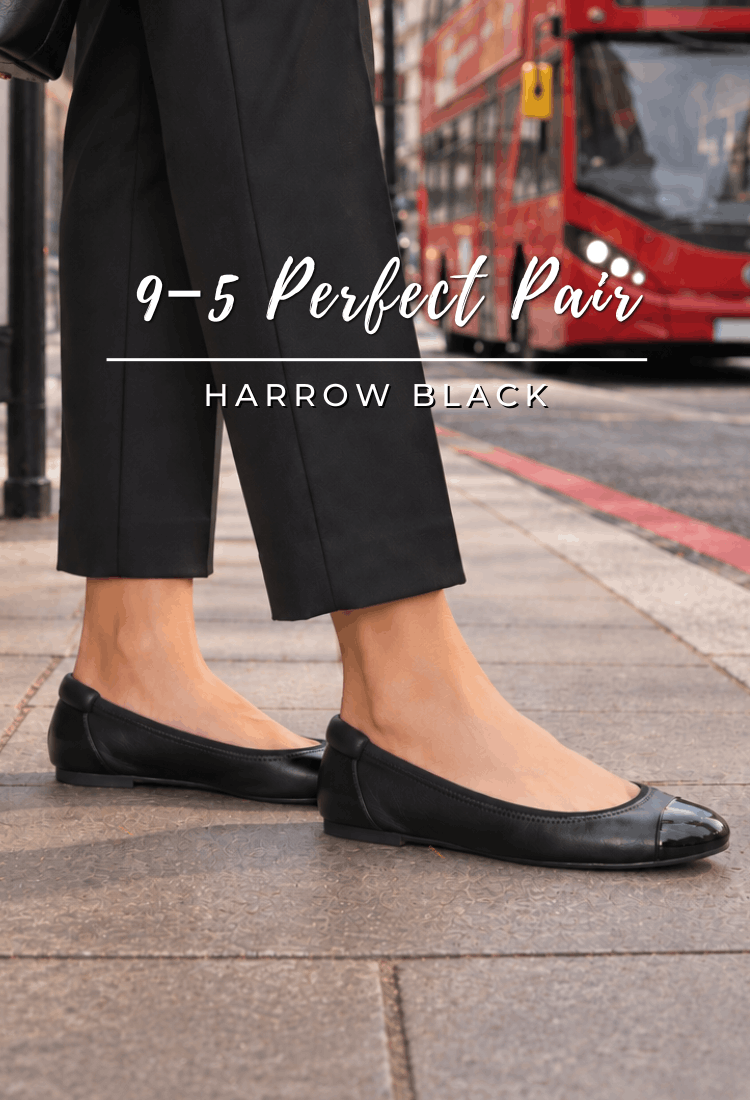
What has particularly caught my attention at Westfield is how often those ballet flats are being worn with what are clearly work outfits.
Tailored trousers. Smart coats. Blazers. Dresses. Skirts. Work bags.
It makes perfect sense. The ballet flat occupies an interesting position in a working wardrobe: polished and considered, but also practical for a day that doesn't necessarily involve sitting behind a desk.
And that raises a more interesting question than simply “Can you wear ballet flats to work?”
Of course you can.
The real question is: how do you choose ballet flats that work for your working life?
Are ballet flats appropriate for work?
Yes — but what counts as appropriate depends on where you work, what you do and what your working day actually involves.
The idea of a single “office shoe” feels increasingly outdated. A woman working at a desk may spend much of her day sitting down but still walk to meetings, commute across a city and go out afterwards. Someone working in a school, hospital, shop, restaurant or studio may spend most of the day on their feet. A business owner might move between meetings, events, customers and errands without ever having a conventional office.
Even within the same workplace, two people can have completely different days.
That is one of the reasons I've always been interested in designing shoes around women's lives rather than designing for an abstract idea of what a woman's life is supposed to look like.
The modern working wardrobe has become much more flexible, too. Smart trainers have become normal in many workplaces. Loafers have become everyday shoes rather than strictly formal footwear. Tailoring is often worn with much more relaxed pieces than it once was.
Against that backdrop, a well-made ballet flat doesn't look out of place at all.
In fact, its simplicity can make it particularly appealing.
Are ballet flats professional?
A ballet flat can look every bit as professional as a loafer, court shoe or other traditional work shoe. The difference is usually in the styling and the shoe itself, rather than the fact that it is flat.
A beautifully finished leather ballet flat worn with tailored trousers and a blazer creates a very different impression from a very casual fabric pump worn with jeans.
This is where I think the current ballet-flat renaissance is interesting. The silhouette has remained familiar, but designers are playing with materials, colours, embellishment, straps, proportions and finishes. British Vogue has described ballet pumps as one of the key flat-shoe styles of 2026, while its coverage of the current trend specifically highlights ballet flats with tailored trousers as a combination that sits between polished and practical.
So “professional” doesn't have to mean severe.
There is room for softness, colour and personality in a work wardrobe.
And, thankfully, there is no rule that says looking professional requires a heel.
What makes a good ballet flat for work?
This is where the question becomes much more interesting.
A ballet flat might look perfect with your work clothes, but if you're still thinking about your feet by lunchtime, it isn't doing its job particularly well.
For a working shoe, I'd look at several things.
Fit comes first
A beautiful ballet flat that doesn't fit properly will never become a comfortable work shoe.
The shoe should feel secure without squeezing, and your foot shouldn't be sliding around inside it. The topline needs to hold the shoe comfortably against the foot without digging in, particularly around the back of the ankle.
This matters because work often means wearing the same shoes for considerably longer than you might wear them for a quick trip somewhere.
And feet can change during the day. Swelling, heat and movement can all alter how a shoe feels after several hours.
I've written more about one of the most common problems — rubbing around the back of the ankle — in Why Do Ballet Flats Rub? How to Stop Heels Rubbing.
Look for cushioning, not just softness
Soft isn't necessarily the same thing as comfortable.
A shoe can feel beautifully soft when you first put it on but still lack the cushioning or structure you need once you've been wearing it for hours.
For work, I want the shoe to feel comfortable at 9am and still feel like the right shoe at 4pm.
That's one reason cushioning matters. So does the way the sole behaves when you move.
Our own ballet flats are deliberately designed as softly structured shoes: flexible to move naturally with the foot, but with cushioning and protection rather than simply being a very thin layer between your foot and the ground.
If you're interested in the thinking behind that approach, I've written about it in Comfortable Ballet Flats: What Designing the World's First Foldable Shoe Taught Me About Comfort.
Consider the materials
Leather remains a particularly useful material for a work ballet flat because it can combine structure, breathability and a polished appearance.
But “leather” alone doesn't tell you whether a shoe will be comfortable.
The construction matters, as does the lining, cushioning and fit.
And the same is true of non-leather materials. Some can be wonderfully soft and flexible; others can trap heat or moisture and become less comfortable as the day goes on.
This is why I tend to look at the shoe as a whole rather than judging it by one feature.
Think about how long you'll actually wear them
Your working day might begin with a commute and finish with dinner.
You might walk from the station, spend the morning at your desk, cross the building for meetings, go out for lunch, stand at an event in the afternoon and then walk home.
Or you might genuinely spend most of the day sitting down.
Either way, your shoes need to make sense for the whole day rather than just the moment when you put them on.
And this is where I think foldability can be particularly useful. If you're commuting, travelling between meetings or simply moving through a long day, having a pair of foldable ballet flats means you can easily and conveniently switch your footwear when you need to.
It's one of the reasons I originally developed the foldable shoe in the first place: not because women necessarily need more shoes, but because sometimes the shoes you're wearing at one point in your day aren't the shoes you want to be wearing later.
For more on prolonged wear, see Can You Walk All Day in Ballet Flats? What Makes a Ballet Flat Comfortable for Walking.
Are ballet flats comfortable for standing all day?
They can be, provided the particular shoe has been designed and constructed for prolonged wear.
This is an important distinction because “flat” doesn't automatically mean “comfortable”.
A completely flat, minimally constructed shoe can leave you with very little cushioning or protection. Conversely, a shoe can have a more substantial sole and still feel rigid or disconnected from the way your foot moves.
Comfort comes from the combination.
Fit. Flexibility. Cushioning. Materials. Construction. The way the shoe stays on your foot.
And then there's something else that I think is often overlooked: distraction.
A comfortable shoe doesn't demand your attention.
You don't have to keep adjusting it. You don't spend the afternoon wondering whether you should take it off. You aren't calculating how far you still have to walk before you can sit down.
That matters during a working day.
I wrote about this idea in The Shoes That Let You Forget About Your Feet, because I think it gets to the heart of what good everyday footwear should do.
Can comfortable shoes encourage you to walk more during the working day?
I've been thinking about this quite a lot recently because I've been persuaded to join a group of friends on a walking and step-counting app, and I've been struck by how effective a little friendly encouragement can be.
Seeing what your friends are doing, trying to keep up and having that gentle sense of accountability can make you walk more without necessarily setting out with the intention of doing so.
And that has made me think about the working day.
Walking isn't necessarily something we set aside an hour to do. It happens in the spaces between everything else: walking to the station, taking the stairs, crossing the office, heading out for lunch, walking to a meeting or simply taking the longer route home.
Those small journeys add up.
Which brings us back to footwear.
If your shoes are comfortable, they are less likely to become a reason to avoid that extra walk or to spend the day looking forward to taking them off.
I've written about the broader relationship between comfort and walking in Why Comfortable Shoes Make You Walk Further.
I'm not suggesting that a particular shoe will magically make anyone more active. But in my own experience, and in watching how women actually use their shoes, there is an obvious practical point: when your footwear isn't getting in the way, movement becomes easier to accommodate into an ordinary day.
What colour ballet flats are best for work?
There isn't one answer — and I think that's a good thing.
Black ballet flats
Black is the obvious starting point for a work wardrobe because it works with almost everything.
A black ballet flat can be worn with tailoring, dresses, skirts, trousers and jeans, and it can move easily between formal and more relaxed settings.
If you're buying one pair specifically to work hard in your wardrobe, black is difficult to argue with.
Navy ballet flats
Navy can be an excellent alternative if you want something slightly softer than black.
It works particularly well with navy tailoring, denim, grey, cream and many shades of brown.
And because it is still a dark, relatively neutral colour, it can feel just as polished without being quite as predictable.
Beige, brown and nude ballet flats
Beige, brown, nude and other skin-adjacent shades can create a lighter look, particularly with dresses, skirts and summer tailoring.
They can also be useful if you want the shoe to recede slightly rather than becoming a strong part of the outfit.
The important thing is choosing a shade you actually enjoy wearing. “Neutral” doesn't have to mean boring.
Metallics
Silver and gold can absolutely work for the office, particularly when the rest of the outfit is relatively restrained.
I've always loved the way a metallic shoe can change an otherwise simple outfit without requiring anything else to be particularly elaborate.
Metallics are a good reminder that a work shoe doesn't have to be purely functional.
Colour
A coloured ballet flat can be surprisingly useful.
A red, burgundy, green or blue flat can act almost like an accessory, particularly when worn with a relatively neutral outfit.
The return of ballet flats has also brought with it much more experimentation around colour and finish. Current 2026 fashion coverage includes everything from classic black to metallics, embellished styles and colour-pop versions.
If your workplace allows a little more personality, why not use your shoes for it?
Can you wear ballet flats with a suit?
Absolutely.
In fact, tailoring and ballet flats are one of the combinations that has helped make the ballet flat feel particularly relevant again.
A suit with a ballet flat changes the balance of the outfit. A traditional court shoe can make tailoring feel formal and structured; a flat can soften it without necessarily making it casual.
Try a classic black ballet flat with a black, navy or grey suit. Or use a metallic or coloured flat such as red to introduce a little contrast.
The proportions matter too. Wide-leg trousers create a very different silhouette from a slim cigarette trouser, and both work well with ballet flats.
The key is to think about the whole outfit rather than treating the shoe as an afterthought.
British Vogue's 2026 coverage of ballet flats specifically highlights tailored trousers as a natural partner for the silhouette, describing the combination as a balance between soft and smart, wearable and polished.
Can you wear ballet flats to a job interview?
In many workplaces, yes.
But this is one occasion where I'd pay more attention than usual to the culture of the organisation and the role you're applying for.
If you're interviewing for a very traditional corporate position, a polished leather ballet flat in black, navy or another restrained colour may sit naturally within a smart interview outfit.
For a creative industry, fashion business, design role or less formal workplace, there may be considerably more freedom.
The important thing is that your shoes should look intentional.
Clean. Well maintained. Comfortable so that you're not distracted by them.
And, crucially, they should feel like you.
A job interview is not the moment to discover that the shoes you've chosen pinch after an hour.
Are ballet flats suitable for business casual?
This is probably where ballet flats make the most sense.
Business casual has become an increasingly broad category, and the ballet flat sits naturally in that middle ground between dressed-up and relaxed.
Wear them with:
- Tailored trousers and a fine-knit jumper
- Straight-leg trousers and a blazer
- A midi skirt and shirt
- A simple dress and structured jacket
- Dark denim and a blazer, where jeans are appropriate
- A tailored suit worn without a formal heel
The same pair can then often take you beyond the office.
That versatility is part of what makes a ballet flat useful. You're not necessarily buying a shoe for eight hours in an office. You're buying a shoe that can move through different parts of your day.
What are the best ballet flats for different types of work?
I'd be wary of saying there is one “best” ballet flat for a particular profession.
I've spoken to women who wear Cocorose shoes for all sorts of working lives: nurses, doctors, teachers, judges, café owners, retail workers, business owners and office professionals, among others.
Their days couldn't be more different.
Some are standing. Some are walking. Some are travelling between meetings. Some are sitting at a desk. Some are dealing with customers all day. Some are moving constantly between different responsibilities.
What they have in common isn't necessarily their profession, but that their shoes need to keep up with the way they actually live.
For someone in a predominantly desk-based role, appearance and versatility might be particularly important.
For someone who spends hours on their feet, cushioning, fit and freedom of movement become much more significant.
For someone moving between formal meetings and less formal parts of the day, versatility may be the priority.
And for someone working in a more creative environment, the shoe can become part of the outfit rather than simply something functional.
That's why I don't believe in designing one “work shoe” for women.
I believe in designing shoes that can work within women's lives.
Can comfortable ballet flats still look stylish?
This is perhaps the question I care about most because somewhere along the way, women were given the idea that comfortable shoes were the sensible choice and stylish shoes were the exciting choice.
I don't think we need to accept that compromise.
When I began developing Cocorose, the problem I was trying to solve was practical: I wanted a shoe that could fit more easily into women's lives.
But that has never meant designing something purely functional.
I care enormously about colour, materials, proportions, detailing and the way a shoe looks when you put it on. Fashion is part of the reason we want a particular shoe in the first place.
The challenge is bringing those things together.
A shoe can be beautiful and comfortable.
It can be feminine without being delicate.
It can be practical without looking utilitarian.
And it can be completely flat without looking like you've compromised on style.
That's one of the reasons I think the current ballet-flat renaissance is more interesting than simply another fashion cycle.
The silhouette has returned, but it is being interpreted in all sorts of ways — from very minimal leather flats to mesh, Mary Janes, metallics, embellishment and hybrid styles.
The ballet flat has always been adaptable and we're simply seeing that adaptability again.
So, what should you look for in a work ballet flat?
If you're choosing a pair specifically for work, I'd start with your day rather than the shoe.
Ask yourself:
- How much am I sitting?
- How much am I standing?
- How much walking is involved?
- Do I commute?
- Do I move between different environments?
- Is my workplace formal, relaxed or somewhere in between?
- Will I wear these shoes beyond the office?
Then look at the shoe itself.
Does it fit securely? Does it feel comfortable immediately? Does it have enough cushioning for the hours you'll spend in it? Is it flexible without feeling flimsy? Does the material work for the environment you're wearing it in? And, perhaps most importantly, do you actually like looking at it?
Because you're going to be wearing it a lot.
The right work shoe isn't necessarily the most traditional one, the most expensive one or the one that looks most like a conventional “office shoe”.
It's the one that makes sense for your working life.
Ballet flats and the modern working wardrobe
Perhaps this is why I've enjoyed watching shoes at Westfield so much this week.
You see the ballet flat being worn in ways that would have felt entirely normal twenty years ago, alongside ways that reflect how much working life and fashion have changed since then.
The ballet flat has never really gone away. But its return to the centre of fashion has given women another reason to look at it afresh.
And perhaps that is what makes the current renaissance particularly interesting.
We're no longer choosing between looking professional and feeling comfortable.
We're asking a better question:
Can my shoes work as hard as I do?
For many women, a beautifully considered pair of ballet flats may be exactly the answer.
And that's exactly what I think a good everyday shoe should do.
It should fit into your life so naturally that you stop thinking about the shoe — and get on with everything else.


Please leave a comment if you wish
This site is protected by hCaptcha and the hCaptcha Privacy Policy and Terms of Service apply.