
Article: Comfortable Ballet Flats: What Designing the World's First Foldable Shoe Taught Me About Comfort
Comfortable Ballet Flats: What Designing the World's First Foldable Shoe Taught Me About Comfort
For decades, women have accepted a simple trade off. Heels are for style. Flats are for comfort. It seems such an obvious conclusion and so many accept it almost instinctively. And yet, over the past two decades of building Cocorose, designing flats and talking to thousands of women, I have discovered that reality is far more complex than simply labelling high heels as uncomfortable and flats as comfortable. As it turns out, comfort is far more sophisticated than simply removing a heel.
Ironically, the idea for Cocorose was never born from a dislike of high heels. In fact, I loved wearing them. Like so many women, I loved how they completed an outfit, how they made me feel a little taller and, perhaps, a little more confident. There is something undeniably special about slipping on a beautiful pair of heels before heading to work, meeting friends for dinner or dressing for an occasion.
The problem with heels, as I was very familiar with, was never the beginning of the day. It was always the end. By late afternoon, my feet were pleading for relief and they felt like they were on fire. Every step became a negotiation. I found myself looking forward to the moment I could finally take my shoes off, not because the day was over, but because the discomfort had become impossible to ignore.
The obvious answer to my problem, therefore, seemed to be a pair of flats. Except that, at the time, they rarely felt like a genuine alternative. Most comfortable shoes looked exactly that: comfortable, sensible, practical and safe. They were the sort of shoes you wore because you had given up on style for the day. They solved one problem while actually creating another. I never wanted to choose between feeling comfortable and feeling like myself.
That was the beginning of Cocorose.
My mission was never to persuade women to stop wearing heels, but my belief was that beautiful flats should never feel like a compromise. Comfort, style and confidence deserved to exist together. That belief has guided every design decision I have made ever since.
Inventing Something That Didn't Exist
When I founded Cocorose in 2007, foldable shoes simply didn't exist as a product and certainly not as a category. There was nothing to improve upon, as there was no established formula or competitors to study. If this idea was going to work, I would have to invent it from the ground up.
Looking back, the challenge wasn't simply creating a shoe that folded, but it was to create a shoe that women genuinely wanted to wear. The folding mechanism was only part of the story. The shoe itself had to be functional but it also had to look beautiful and, above all, feel luxurious and genuinely comfortable.
I knew that being 'flat' was just one piece of the jigsaw. Even in those earliest conversations with manufacturers, I found myself talking about softness, flexibility, cushioning and the way a shoe should move with your foot rather than resist it. Those were the qualities I had always searched for myself, and I knew instinctively that they mattered just as much as the ability to fold.
The challenge came afterwards.
How do you preserve all of those qualities while asking a shoe to do something no one had ever asked it to do before? How do you make it fold?
When Design Became an Obsession
Like many founders, I became obsessed.
Once I knew the shoes had to fold, another question quickly took over my thinking. How small could they become?
At first, it felt like the perfect design challenge. The smaller the folded shoe, surely the most useful it would be. I imagined women slipping them into tiny evening handbags and elegant clutches without giving the space inside a second thought.
To achieve this, I needed to minimise. If I wanted the smallest possible folded shoe, I simply needed to keep taking things away. Remove another layer of material. Reduce the thickness of the outsole and definitely remove any form of heel. Strip away anything that wasn't absolutely essential.
From a purely engineering perspective, it was fascinating.
From a human perspective, however, it slowly became apparent that I was asking the wrong question.
The Lesson My Prototypes Taught Me
One of the things I love most about product development is that prototypes are wonderfully honest. My earliest prototypes folded into a remarkably compact size and slipped effortlessly into the tiniest handbags. On paper, they achieved exactly what I had set out to create. But wearing them taught me something no drawing or technical specification ever could.
The smallest possible shoe was not necessarily the best possible shoe.
As I wore the prototypes through ordinary days, something became increasingly clear. I wasn't designing an object; I was designing an experience.
That distinction changed everything. I realised that the foldable shoe I created was never going to be judged sitting on a shelf or displayed on a design table but rather, by something altogether more important. The more I tested those early designs, the more I understood that women wouldn't be measuring the success of the foldable shoe by how small it would fold up in their handbag. They would be measuring it by how they felt halfway through a commute, while standing through a presentation or by walking rather than waiting for the next train.
That realisation fundamentally changed my approach to product development. Until then, I had been designing the product itself. From that moment onwards, I began designing the experience of wearing it.
Asking a Better Question
Once I stopped thinking solely about how small the shoes folded and started thinking more about the woman wearing them, I found myself asking a much more interesting question.
"How should these shoes make a woman feel?"
At first, I thought I was asking about physical comfort, but I soon realised there was another layer to the answer.
Comfort is not simply a sensation beneath our feet. It changes the way we experience our day. When our shoes feel good, we stand a little taller. We walk further without hesitation. We stay longer at the party, accept the invitation to dinner after work and explore one more street while travelling. We stop thinking about discomfort and start paying attention to the moments that really matter.
Somewhere along the way, I realised I was no longer designing purely for comfort. I was designing for empowerment, confidence, freedom and peace of mind.
That emotional journey deserves a deeper conversation in its own right, but physically, comfort is rarely created by a single feature. It isn't found by measuring heel height, adding thicker cushioning or making a shoe softer than everything else on the market. If it were that straightforward, every comfortable shoe would feel exactly the same.
Instead, comfort is the result of many thoughtful decisions working together.
Women rarely describe comfort in technical terms. They don't talk about millimetres or construction methods. They talk about how a shoe allowed them to forget about their feet altogether.
And this, perhaps, is the highest compliment any shoe can receive.
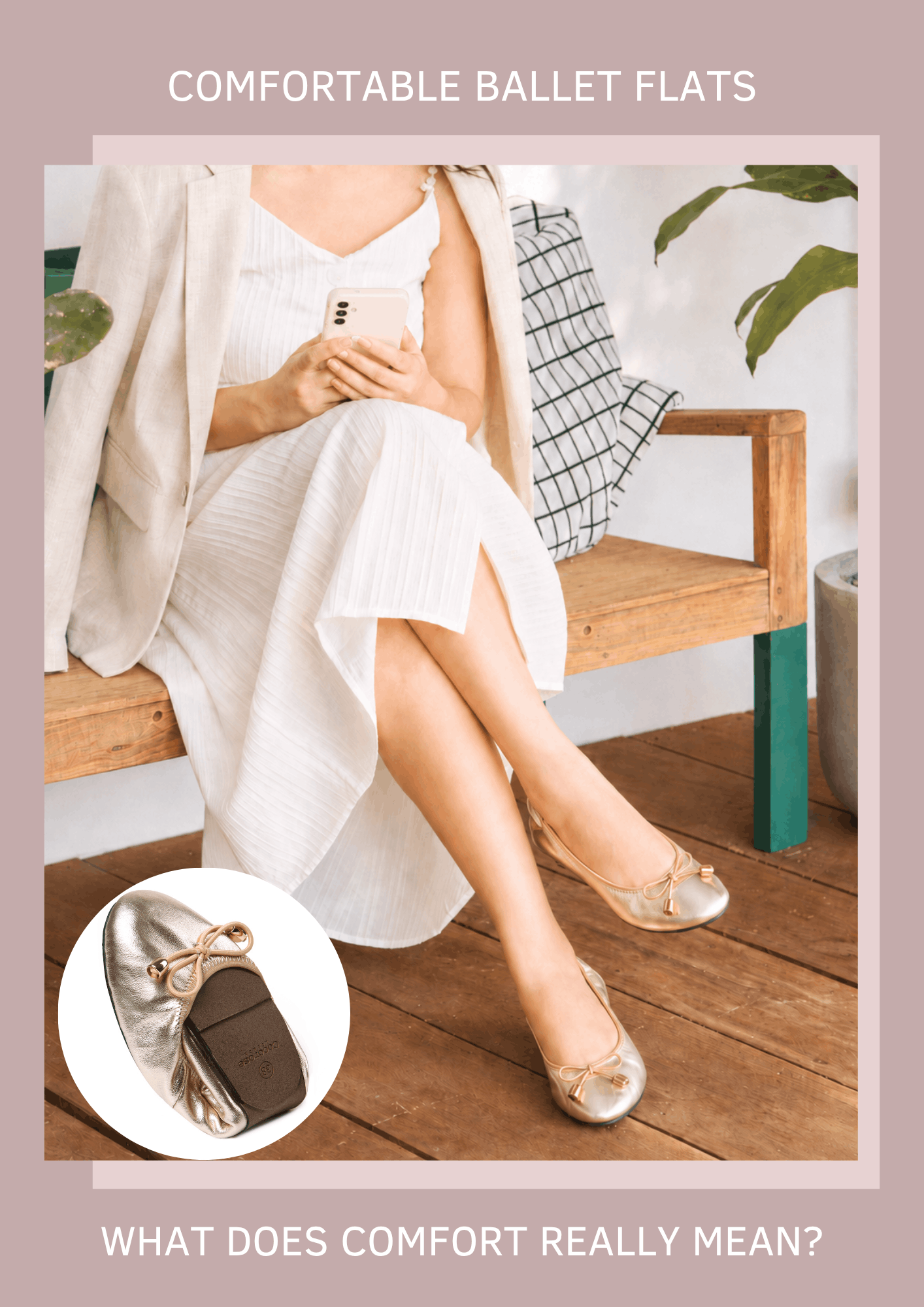
Armed with this knowledge, I redesigned my foldable shoe and intentionally created an everyday shoe that folds. This very simple but profound distinction between a foldable shoe and a shoe that folds challenged me to create the best ballet flats possible. The softness of the leather, the deep cushioning and the pillowed padding to caress and support the foot. I redesigned the outsole and introduced a subtle heel to help combat daily impact on our feet and legs. The shoes still folded compactly into their travel pouch, yet they now offered the reassurance underfoot that women truly appreciate after hours of walking, standing and simply getting on with life.
Looking back, I think I made my foldable shoes more honest to real life. They weren't designed to impress on a specification sheet. They were designed to improve someone's day.
Why Flat Does Not Automatically Mean Comfortable
This is where I think the conversation around footwear sometimes becomes oversimplified and increasingly polarised.
For years, we were encouraged to believe that high heels were the problem. More recently, the conversation has shifted towards minimalist footwear and barefoot shoes, with the suggestion that the flatter a shoe becomes, the healthier and more comfortable it must surely be.
As with many debates, there is truth on both sides, but neither tells the whole story.
High heels certainly place additional demands on the body, particularly when worn for long periods. Equally, extremely minimalist flat shoes with no cushioning and support also place additional demands on the body, despite allowing the foot to move naturally.
However, I have never believed that removing every trace of height or cushioning is automatically the answer.
Our feet spend much of modern life walking across hard surfaces that previous generations encountered far less frequently. Pavements, railway stations, office buildings, airports and shopping centres all generate repeated impact, and over the course of a day, those small forces accumulate. By the evening, many women are not simply experiencing tired feet, but are feeling the effect of thousands of tiny impacts travelling through the body which can go on to create other health issues in later life.
That is why I have never viewed cushioning as the enemy of natural movement. Thoughtful cushioning does not exist to prevent the foot from working naturally. It simply helps to soften those repeated impacts from modern life, minimising potentially debilitating effects on our joints in years to come.
Learning From the Barefoot Conversation
The growing interest in barefoot shoes has, in many ways, been a positive development.
It has encouraged more people to think deeply about their feet and about the way shoes interact with our bodies. Conversations around flexibility, toe space and natural movement have challenged many of the assumptions that the fashion and footwear industry held for decades, and I think that is something to celebrate.
They encourage us all to think more carefully about how footwear should support the way we live.
As a designer, I find those discussions genuinely fascinating.
Where my own philosophy differs from the more extreme interpretations of the trend is in the belief that movement and protection are not opposing ideas.
Modern life is wonderfully varied and the demands we place upon our feet to keep up with our pace can be surprisingly demanding. The best shoes, in my experience, are those that strike a thoughtful balance. They move naturally with the foot while still offering the softness, flexibility and cushioning that make modern life more comfortable and better for our long term wellbeing.
The Philosophy That Still Guides Cocorose
When people ask me what makes a comfortable shoe, I sometimes think they are expecting a technical answer. Perhaps a particular material. A specific heel height. Or even a precise amount of cushioning.
Those things all matter, of course, but they are not where I begin.
Shoes should be designed around the lives we lead; not the other way round. To me, what makes a comfortable shoe is one that allows you to move through your day with confidence, comfort and the quiet assurance that your footwear is supporting you rather than demanding your attention.
When that happens, something rather wonderful occurs. The shoe slowly disappears from your thoughts. Not literally, of course, but mentally. You stop thinking about your feet and start thinking about the conversation you're having, the place you're exploring or the people you're with. The shoe has done its job, leaving you free to enjoy everything else.
That simple observation stayed with me long after I finished writing this article. In fact, it became the starting point for another question entirely: what if the greatest compliment a shoe can receive is that you forget you're wearing it? I explore that idea in The Shoes That Let You Forget About Your Feet, where I look at how thoughtful footwear gives us something even more valuable than comfort. It gives us our attention back.
For me, that has always been the true measure of comfort.
It is not found in a specification or a measurement.
It is found in the freedom to forget that you are wearing the shoes at all.
If you would like to explore the principles behind thoughtful footwear in greater depth, our Ultimate Guide to Foldable Shoes brings together the stories, design philosophy and practical insights that have shaped Cocorose from the very beginning.

Please leave a comment if you wish
This site is protected by hCaptcha and the hCaptcha Privacy Policy and Terms of Service apply.