
Article: Why Do Ballet Flats Rub? How to Stop Ballet Flats Rubbing Your Heels
Why Do Ballet Flats Rub? How to Stop Ballet Flats Rubbing Your Heels
Prior to Cocorose, I was obsessed with finding soft leather ballet flats that wouldn't pinch the backs of my heels. Believe it or not, it was far more challenging than it sounds.
I had suffered through more than my fair share of pinched Achilles heels, sore welts and ballet flats that looked beautiful but became uncomfortable surprisingly quickly. I wanted stylish shoes that I could put on and simply wear. I didn't want to spend weeks hoping the leather would eventually soften or wondering whether the back of the shoe would finally stop digging into my skin. I wanted comfort from the first wear.
It seems I was always on the hunt for comfortable footwear, and in many ways, that search was where the story of Cocorose London began. What I didn't appreciate at the time was just how much those seemingly little details would influence the shoes I would eventually design. A pinching Achilles might sound like a minor irritation, but when it happens every time you wear a pair of shoes, it becomes anything but minor.
Those experiences made me question the construction of the traditional ballet flat. Why did the shoe need to be so rigid? Why did the back have to be constructed in a way that would create pressure against such a sensitive part of the foot? Could a ballet flat be soft and flexible without becoming flimsy? And could I completely rethink the construction rather than simply trying to make an existing design more comfortable?
The answer led me to deconstruct the ballet flat. In fact, there were two reasons why I needed to do it, and both have shaped our shoes ever since.
Why Did I Deconstruct the Traditional Ballet Flat?
When I first began developing the world's first foldable shoe, I quickly realised that I couldn't simply take a conventional ballet flat and somehow make it fold. The construction itself had to be reconsidered. I needed to think about the shoe differently, take it apart conceptually and then rebuild it with foldability at its core.
But foldability was only half of the equation.
I also wanted to solve the comfort problem that had frustrated me for years. I didn't want to make a ballet flat that was simply more flexible because it needed to fold. I wanted a shoe that felt soft against the foot, moved naturally as I walked and incorporated cushioning and padding in the places where it would actually make a difference.
So the deconstruction became a two pronged approach. I needed to deconstruct the ballet flat to engineer foldability, and I needed to deconstruct it to properly engineer comfort. The two objectives became much more closely connected than I had initially imagined.
Once I stopped treating the traditional construction as something that had to be followed, I could start asking different questions. Which parts of the shoe really needed to be rigid? Where did the foot need support? Where did it need freedom to move? Where would a seam or edge create unnecessary pressure? How could the shoe stay securely on the foot without gripping it too tightly?
The result is what I think of as a softly structured ballet flat. It has structure to support and protect the foot, but without imposing unnecessary rigidity. It is flexible to work with the foot's natural movement, with pillowing and padding in the places where the foot is most vulnerable to pressure. It feels grounded rather than bulky, while still providing the cushioning and support you expect from an everyday shoe.
This is also where the story of the foldable shoe and the story of our comfortable ballet flats become inseparable. The construction that allowed me to engineer foldability also gave me the freedom to rethink how the shoe behaved on the foot. I explore that evolution in my Founder Essay, The Everyday Shoe That Folds, where I share how the original foldable shoe continued to evolve into an exceptional everyday ballet flat that simply happens to fold when needed.
I wasn't simply making a ballet flat that folded. I was rethinking what a ballet flat could be.
Why Do Ballet Flats Rub the Back of Your Heels?
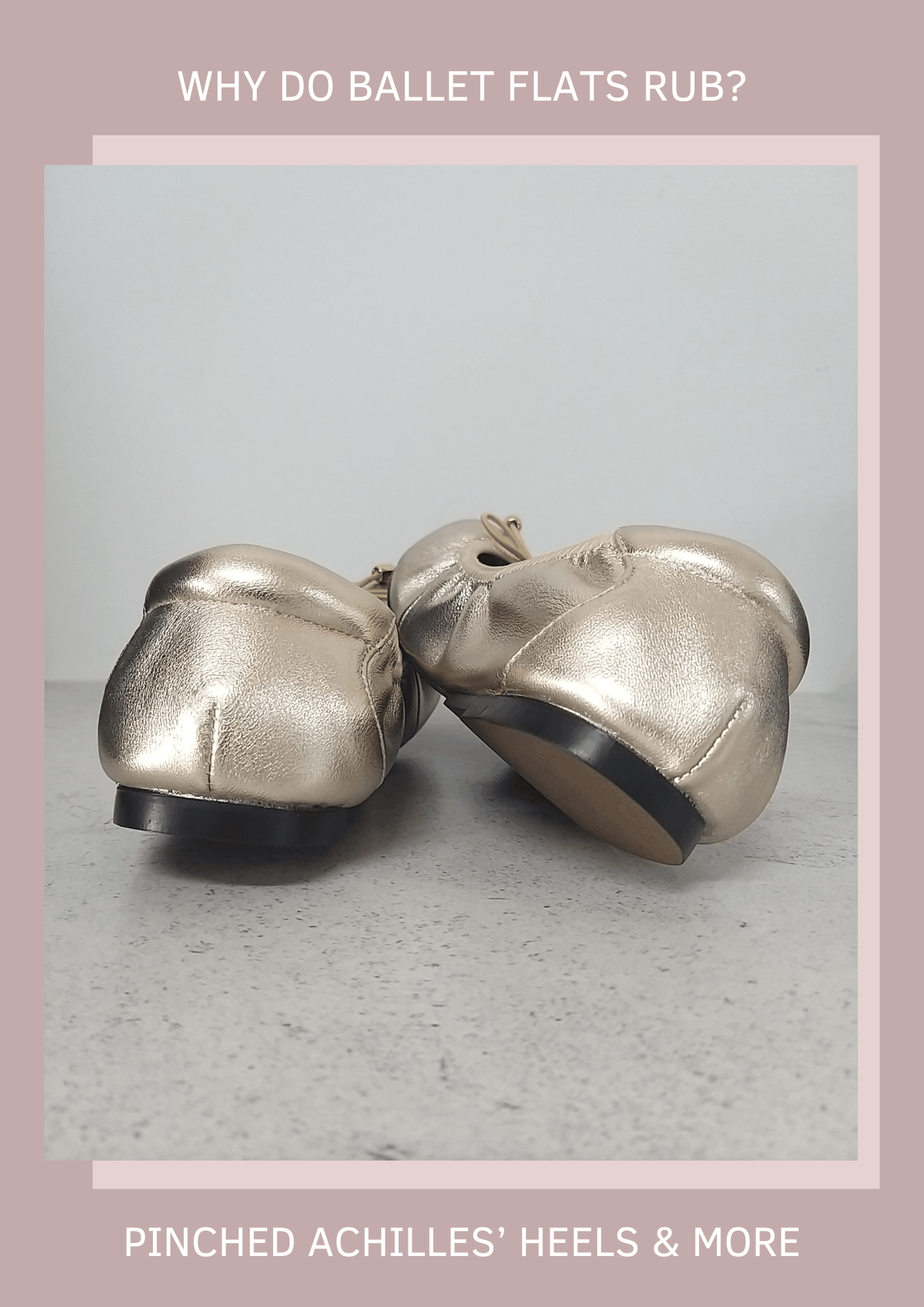
The back of a ballet flat is a deceptively complicated area. There is very little material between the shoe and the Achilles, and the shoe has to stay securely in place while the foot moves through every step.
Traditionally, the topline of a ballet flat comes together at the back and is stitched down the centre seam. That seam can sit directly against the Achilles, creating a point of contact that is repeated every time you walk. An elasticated topline can solve some of the problems associated with a rigid opening, but if the elastic is too tight, poorly positioned or joined directly at the back, it can create another source of pressure.
This is why I became so particular about the construction around the Achilles. The area is already involved in the mechanics of walking, with the Achilles tendon connecting the calf muscles to the heel bone and contributing to propulsion. Research has demonstrated that footwear can influence Achilles tendon loading, although the research itself has focused on other types of footwear rather than everyday ballet flats. The research can be read on PubMed.
The important point isn't that one particular construction is universally right or wrong. It is that where a shoe meets the foot matters. A small seam, an edge or a little too much pressure can become disproportionately irritating when that contact is repeated throughout the day.
This is one of the reasons the backs of our ballet flats have received so much attention over the years. With a pillowed Achilles heel, there is no seam that presses on this sensitive area. My own experience of pinched Achilles heels made me acutely aware of how much difference these apparently insignificant details can make.
What Actually Causes a Ballet Flat to Rub?
We use the word "rubbing" very casually, but the science behind a friction blister is considerably more interesting than the word suggests.
A recent review of friction blister research challenged the traditional explanation that blisters are simply caused by heat, moisture and surface rubbing. Instead, it describes blister formation in terms of repetitive shear deformation. Movement of the underlying bone, frictional force and repetition of those forces all contribute to the damage that can eventually occur within the skin. Read the review on PubMed.
That helps explain a familiar experience. You put your ballet flats on in the morning and everything feels fine. You walk to work and, somewhere along the way, you become aware of a niggling feeling at the back of your heel. Something is rubbing. It's not quite painful yet, but you're conscious of it with every step. As the day continues, the irritation becomes harder to ignore and you find yourself looking for a blister plaster because the blister has already started to form. By dinner time, your heel is so sore that walking properly has become difficult, and suddenly the dinner you had been looking forward to feels like something you simply can't face.
Blisters can develop surprisingly quickly when the mechanical conditions are right. In one controlled laboratory study of friction blister formation on the heel, 77% of participants developed a blister within 18 minutes of the experimental loading being applied. The conditions were very different from everyday walking, so the study shouldn't be used to suggest that a ballet flat will cause a blister within a particular number of minutes, but it does illustrate how quickly repetitive mechanical loading can damage the skin. Read the study on PubMed.
The shoe hasn't necessarily changed dramatically during those few hours. The interaction between your foot and the shoe has. A small amount of movement that is insignificant once becomes significant when it is repeated again and again, particularly as your feet become warmer, your skin becomes more hydrated and the shoe continues to move against the same area.
Research has found that increased skin hydration can increase the risk of friction blister formation under controlled conditions. Read the study on PubMed. Other research has also found a relationship between skin hydration and the frictional behaviour of skin.
That doesn't mean that moisture alone causes blisters, or that a particular material will automatically prevent them. Footwear is an interaction between the shoe, the skin and the way the foot moves. It is the combination that matters.
Why Is the Topline So Important in a Ballet Flat?
The topline is the opening of the ballet flat that sits around the foot, and it has a surprisingly demanding job. It needs to hold the shoe securely without putting excessive pressure on the foot, while allowing enough flexibility for the shoe to move naturally as you walk.
A rigid topline leaves relatively little room for variation in the shape of individual feet. If it is too loose, the foot can lift out of the shoe with each step, creating repeated movement. If it is too tight, the edge can dig into the foot and create pressure, soreness or blisters.
A gently elasticated topline gives the shoe some ability to adapt. It can help keep the ballet flat securely positioned while allowing the opening to accommodate the foot rather than forcing the foot into a fixed shape.
But the tension matters enormously. Elastic that is too tight can be just as uncomfortable as a rigid topline, particularly around the Achilles. I have seen how something as seemingly small as the tension of an elasticated topline can make the difference between a ballet flat that you instinctively reach for and one that you stop wearing.
That is why these details are not afterthoughts in our shoes and they are part of the construction from the beginning.
Can Leather Ballet Flats Rub?
Of course they can. It would be misleading to suggest that choosing leather automatically solves the problem.
There is a huge difference between different types of leather, just as there is a huge difference between different non leather materials. Some leather shoes are exceptionally soft from the first wear, while more heavily structured leather shoes can be quite rigid and may take considerable time to soften. Some non leather shoes are wonderfully soft and flexible, but non leather materials tend to feel hot, sweaty and less breathable after several hours.
That distinction matters because heat and moisture can change the way the foot interacts with the shoe. Research into skin hydration and friction has demonstrated that increased hydration can affect the frictional behaviour of skin, which is one factor in the development of friction blisters.
For Cocorose, soft leather has always been an important part of the experience we want to create. Our ballet flats are designed to feel soft and comfortable from the first wear, rather than relying on a prolonged breaking in period. With continued wear, the leather can become increasingly familiar to the individual shape of your foot, but that is an evolution of an already comfortable shoe.
I think there is an important distinction here.
Leather can soften with wear, but that doesn't mean a leather ballet flat should be uncomfortable when you first put it on.
Do Leather Ballet Flats Need to Be Broken In?
This is one of those pieces of footwear advice that I have never been particularly comfortable with.
There is nothing wrong with leather changing as you wear it. Natural leather can soften, flex and become increasingly shaped to the contours of your foot. That is one of the qualities I love about it.
But I don't think "give it a few weeks and it will eventually become comfortable" should be the standard for a ballet flat.
When I was searching for my own comfortable ballet flats before Cocorose, I didn't want to endure pinching and rubbing while waiting for the shoe to improve. I wanted to put them on and feel comfortable straight away.
That remains my benchmark today.
When I develop a new ballet flat, I wear the samples myself. I don't simply try them on for a few minutes and decide that they look good. I wear them properly, often for days, weeks and sometimes months, because there are things you simply cannot discover in a fitting room.
If a shoe doesn't feel right after prolonged wear, it doesn't pass.
Can Foot Swelling Make Ballet Flats Rub?
It certainly can, and this is another reason why a shoe that feels comfortable at 9am may not feel quite the same at 5pm.
Our feet are not static structures. Their volume can change during the day and in response to factors such as posture. A recent study using MRI and 3D volumetry found a significant increase in foot volume during the day under the study conditions. Read the study on PubMed.
The extent of any change varies enormously between individuals and circumstances. Heat, prolonged standing and walking can all affect how feet feel. A more hidden reason for ballet flats rubbing may also be linked to hormonal changes and pregnancy, which we explore further in our article Hormonal Swelling of Feet and Shoe Fit.
For footwear, however, the principle is simple: the foot inside the shoe at the end of a long day may not be quite the same foot that went into the shoe that morning.
That can be particularly noticeable around the topline. A gentle fit can begin to feel tighter as the foot changes in volume, and a small amount of additional pressure around the Achilles can become increasingly noticeable.
It is one of the reasons I think comfort has to be considered over the course of an entire day rather than judged by a few minutes in front of a mirror.
If your ballet flats are comfortable when you leave home but start rubbing shortly afterwards, foot swelling may be part of the explanation. It is also worth looking at whether the shoe has enough flexibility and adaptability to accommodate those changes.
Why Do My Ballet Flats Rub One Foot but Not the Other?
Feet are remarkably individual, and there is no reason to expect the left and right foot to behave in exactly the same way.
There may be subtle differences in width, length, volume or shape, and we don't necessarily distribute our weight identically on both sides when we walk. One foot may be slightly larger, wider or fuller than the other, and even a small difference can change the way a ballet flat sits against the foot. A shoe that feels perfectly comfortable on one foot can therefore create a little more pressure or movement on the other.
There is another factor that is easy to overlook. Shoes are individual objects too. Whether they are made by hand or by machine, there will always be tiny variations between one shoe and another. With handcrafted shoes in particular, those subtle differences are part of the nature and charm of something that has been made by hand. The left and right shoe may not be absolutely identical in every minute detail, even though they have been made to the same specifications.
When you put those two things together, it is entirely possible for one foot to experience slightly more rubbing than the other. It doesn't necessarily mean that anything is wrong with your feet or that the shoes are faulty. Sometimes it is simply the result of the very individual relationship between your feet and your shoes.
How Can You Stop Ballet Flats Rubbing Your Heels?
There are plenty of quick fixes for rubbing: blister plasters, heel protectors, powders, anti friction products and various forms of padding. Some can certainly be useful in particular circumstances, especially when you're dealing with an existing sore area.
But I think it is worth going one step further and asking why the shoe is rubbing in the first place.
If the foot is moving excessively inside the shoe, the underlying issue may be fit. If the topline is pressing against the Achilles, adding another layer of material underneath it may actually increase the pressure. If a seam is creating the irritation, protecting the skin doesn't change the construction of the shoe.
Interestingly, the evidence behind some traditional blister prevention methods is not as straightforward as the abundance of products available might suggest. Research has investigated topical products, powders and other approaches with mixed findings, which reinforces the importance of understanding the mechanical cause rather than simply treating the symptom.
For me, the better solution is to start with the shoe itself.
A comfortable ballet flat should hold the foot securely without gripping it. It should allow the foot to move naturally without excessive movement inside the shoe. The areas most vulnerable to pressure should have been considered during the construction, rather than being left for the customer to solve afterwards.
That is fundamentally how I approach footwear design.
Why Does Flexibility Matter in a Ballet Flat?
A foot is designed to move, and I have always believed that a shoe should accommodate that movement rather than unnecessarily restricting it.
That doesn't mean a ballet flat needs to be flimsy or completely unstructured. Support, protection and cushioning still matter enormously. What I wanted to avoid was unnecessary rigidity: structure that existed simply because that was how the traditional ballet flat had always been constructed.
This was another reason why deconstructing the traditional ballet flat was so important. Once I began rebuilding the shoe around foldability and comfort, I could think much more carefully about where structure was genuinely useful and where flexibility would allow the shoe to work more naturally with the foot.
Ultimately, flexibility matters because we want a soft ballet flat that moves naturally with the foot. The shoe should flex as you walk rather than making the foot work against a rigid structure, while still providing the support and cushioning needed for everyday wear.
What Makes a Ballet Flat Comfortable From the First Wear?
Comfort isn't one feature that can simply be added to a finished shoe. It comes from the relationship between the materials, construction, fit, flexibility, cushioning and the way the shoe moves with the foot.
The leather needs to feel soft. The topline needs to hold the shoe securely without digging into the foot. The back of the shoe needs to avoid unnecessary pressure against the Achilles. The sole needs enough flexibility to move with the foot, while the cushioning needs to be placed where it is genuinely useful.
Those elements are interconnected. That is why I don't think you can take a traditionally rigid ballet flat, add a cushioned insole and call the job finished. If the construction is fundamentally working against the foot, additional cushioning can only go so far.
This is what the deconstruction taught me. Comfort needs to be considered from the beginning. It needs to influence the way the shoe is built, rather than being something added once the shape and construction have already been decided.
That principle has stayed with Cocorose from the very first foldable shoe to the ballet flats we make today. I explore the thinking behind this in much more detail in my Founder Essay, Comfortable Ballet Flats: What Designing the World's First Foldable Shoe Taught Me About Comfort.
What Have Twenty Years of Designing Ballet Flats Taught Me About Comfort?
Probably that the smallest details can have the biggest consequences.
Over nearly twenty years, our customers have told me about the realities of wearing shoes that you can't always discover in a fitting room. They've talked about commuting, travelling, standing at weddings, walking through airports, spending hours on their feet and wearing their Cocorose shoes all day rather than simply carrying them as an emergency pair.
They've also told me when something isn't quite right.
That feedback is invaluable because comfort isn't really about the first five minutes. It is about what happens after three hours, six hours or an entire day.
This is also why I test every prototype myself. I have ended up wearing a particular sample almost exclusively for weeks because I wanted to understand exactly how it behaved. If something begins to pinch, rub, feel too narrow or simply become uncomfortable after prolonged wear, I need to know about it.
Our customers shouldn't have to discover those things for themselves.
I design and test so they don't have to.
This way of thinking about footwear is part of a much bigger philosophy for me: designing shoes around the wonderfully varied lives women actually lead. I explore that in my Founder Essay, Designing Shoes Around Women's Lives.
What Should You Look for When Choosing Ballet Flats That Won't Rub?
There is no single feature that guarantees a ballet flat will be comfortable, because feet are individual and shoes vary enormously in their construction. But there are certain things worth paying attention to when you are choosing a pair.
Look closely at the back of the shoe. Is there a seam positioned directly against the Achilles? Does the topline feel as though it is gently holding your foot or pressing into it? When you walk, does the shoe stay in position or does your heel repeatedly lift out?
Pay attention to the material, too. Softness matters, but so does how the material behaves when you are wearing it for several hours. A shoe that feels wonderfully soft in your hands isn't necessarily going to be comfortable on your feet if the fit or construction is wrong.
These are some of the details I explore in more depth in What Makes A Great Foldable Shoe?, where I look at the construction, cushioning, flexibility, Achilles padding and materials that can make the difference between a shoe that simply folds and one that is genuinely comfortable to wear.
And don't judge the shoes solely by standing still.
Walk in them.
Your foot changes shape as you move, and the relationship between the shoe and the foot becomes much easier to understand when you're actually taking steps.
Most importantly, don't accept the idea that a beautiful ballet flat has to be uncomfortable.
That was one of the things that frustrated me long before Cocorose existed. I couldn't understand why finding a stylish ballet flat that didn't pinch my Achilles seemed to be such a difficult task.
So I decided to rethink the shoe.
That decision has influenced almost two decades of Cocorose design.
Why the Best Ballet Flats Are the Ones You Forget About
There is a point with genuinely comfortable shoes when you realise you haven't thought about your feet for hours. You're not wondering whether the back of the shoe is going to start rubbing. You're not thinking about when you'll next be able to sit down. You're not noticing pressure building around your toes or wondering whether you should have worn something else.
You're simply getting on with your day.
That, to me, is the real meaning of comfort.
It isn't about making a shoe as soft as possible or filling it with as much cushioning as possible. It is about creating a shoe in which all the different elements work together so naturally that your feet are free to get on with everything else.
That was what I was looking for when I was searching for my own soft leather ballet flats all those years ago. It is still what I look for today, and it is why those seemingly little details have mattered so much throughout the story of Cocorose: the pillowing around the Achilles, the carefully considered topline, the softness of the leather, the flexibility, the cushioning and the way the shoe moves with the foot.
Individually, they may not seem revolutionary. Together, they can completely change the experience of wearing a ballet flat.
For me, that is the real lesson of almost twenty years of designing shoes. Comfort isn't something you add to a shoe at the end. It has to be there from the beginning.
I wrote more about this idea in my Founder Essay, The Shoes That Let You Forget About Your Feet, which explores what it really means to create shoes that become so comfortable you stop thinking about them.
Frequently Asked Questions About Ballet Flats Rubbing
Why do my ballet flats rub my heels?
Ballet flats can rub when repeated movement between the foot and shoe creates friction and shear. The fit, topline, seams, materials, moisture and the way the shoe moves with your foot can all contribute to discomfort and blister formation.
How do I stop ballet flats rubbing the back of my heels?
Start by identifying exactly where the irritation occurs. Check the fit of the topline, look for seams or pressure points around the Achilles and consider whether your foot is moving excessively inside the shoe. If your feet tend to swell during the day, also consider how the shoes feel later in the day rather than judging them only when you first put them on.
Should new leather ballet flats rub?
They shouldn't cause significant or painful rubbing simply because they are new. Good quality soft leather can become increasingly shaped to your foot with wear, but a comfortable ballet flat should feel comfortable from the first wear.
Do leather ballet flats need to be broken in?
Not necessarily. Leather can soften and become increasingly familiar to the shape of your foot with wear, but this shouldn't mean enduring painful rubbing or blisters while waiting for the shoes to become comfortable.
Can an elasticated topline stop ballet flats rubbing?
A correctly designed elasticated topline can help keep the shoe securely positioned while allowing the opening to adapt to the foot. However, if the elastic is too tight or poorly positioned, it can itself create pressure and discomfort around the foot or Achilles.
Can sweaty feet cause ballet flats to rub?
Heat and moisture can influence the interaction between skin and footwear. Research has found that increased skin hydration can increase susceptibility to friction blister formation under controlled conditions.
Can swollen feet make ballet flats rub?
Yes. Foot volume can change during the day, and research has demonstrated measurable changes in foot volume in healthy people. If your feet become more swollen, a shoe that felt comfortable earlier may feel tighter later, increasing pressure or changing how your foot moves inside the shoe.
Why does one ballet flat rub but not the other?
Feet can differ slightly in shape and volume, and you may also move or distribute your weight differently on each side. Paying attention to the precise location of the rubbing can help identify whether the problem relates to the topline, Achilles area, a seam or the overall fit.

Please leave a comment if you wish
This site is protected by hCaptcha and the hCaptcha Privacy Policy and Terms of Service apply.